
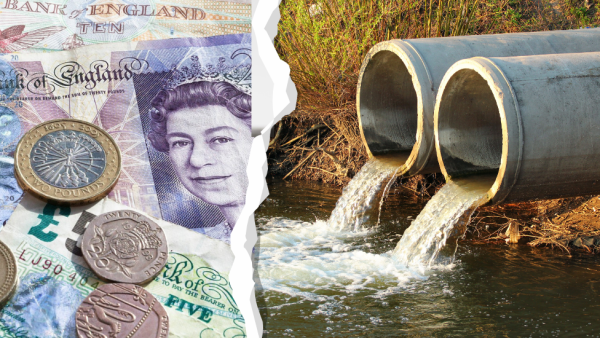
Before 1989, England and Wales’ sewer services were run by public bodies, the Regional Water Authorities. The government decided to privatise these firms by selling each company’s assets to a newly formed company, which had right to operate officially in certain areas. The company assigned to London and surrounding areas was Thames Water
Market Structure
Regionally, each company operates as a Natural monopoly1. The presence of multiple competitive companies providing sewer services is highly inefficient, and a competitive market may put consumers in vulnerable positions, however there are advantages of having such a market structure:
- Infrastructurally, having multiple overlapping pipes for different water mains providers would be expensive, time-consuming and would require lots of space. Thus, having only one provider minimises inefficiency in delivering the service.
- Some component of water bills goes towards funding operations for Thames water, this may be funding for maintenance of central equipment such as constructing and running new water reservoirs or debt repayments for Thames Water; The money which goes towards the aforementioned fixed costs, has less financial burden on each consumer since the firms have a large consumer base – should there have been multiple firms, each firm would have fewer customers than one central firm and would therefore need to charge higher water bills to consumers to cover costs.
- Unlike a free market, regulatory organisations have more control over such natural monopolies in order to ensure consumers are not overcharged for a necessary service. (More on this later)
However the system is riddled with flaws:
- The system is dependent on regulation by a third party organisation, leaving it prone to failure. With the absence of competitive pressure there is less incentive to improve service quality or maximize its efficiency – Lack of oversight from Ofwat (the regulatory organisation) has come in the form of: Ignoring fines or major incidents, failing to be realistic about the level of investment required to deliver and maintain infrastructure, or perhaps through their neglect of pipe and leak management.
- The system is vulnerable to collapse. Given that there are no other competitors able to step in, possibly leading to systematic disruption.
Financial adversity
Today Thames Water stands £20 billion in debt, making it the most indebted water supplier in all of England and Wales.
This dates back to how the UK water industry was privatised and financially engineered.
In 1989, Margaret Thatcher’s government privatised the water companies which were sold debt-free. Thames water was given a “green dowry” (a subsidy of cash and assets) to ensure it can invest in infrastructure – in hopes that capital private markets fund the upgrades rather than taxpayers.
In the 1990s-2000s, the owners relied more on borrowing to fund operations rather than equity, for a few reasons:
- Cheaper in the short run: If Thames water is borrowing they only need to pay the interests on the loan, if they used their own money they’d expect bigger returns which cost more than loan interest.
- Interests on loans in taken off before tax is calculated, whereas dividends2 to shareholders are paid after tax – the company is reducing their tax bill.
- If new equity had to be raised (if paying with equity), ownership would be spread across more investors. By borrowing instead, the existing owners of the company keep full control.
In 2006, Thames Water was acquired by Macquarie.
Here it adopted a “highly leveraged financial model”3 where:
- Macquarie borrowed money using Thames Water assets as collateral, (pipes, reservoirs etc). This gave the company billions in cash without having directly paid for it, meaning less risk for Macquarie.
- Paid out £2.8 billion in dividends during its ownership
- Macquarie set up a web of companies above Thames Water, debt was put on these companies and the interest on the debt was charged as an “expense” – meaning it seemed like the profits were lower in the operating company – making it look like Thames Water wasn’t making money even though it was paying out dividends.
Macquarie sold Thames Water in 2017 with £10 billion in debt, almost double the debt value that it had when Macquarie acquired it started. Thames water ownership fell in the hands of pension funds, sovereign wealth funds and infrastructure investors. Rather than investing into the company they continued to have a debt-heavy company
Ofwat began penalising the company for poor performance, including leakages, sewage discharge and company complaints. They imposed fines while at the same time Thames Water was being told to upgrade, with a lack of funds.
Thames water tried to raise equity to strengthen its finances. This equity could reduce its reliance on debt (borrowing) and give the company more stability.
Its preferred investor was KKR, a big US private equity firm.
- In June 2025, KKR pulled out of the deal
- This was down to the Government Hostility towards Thames Water, criticising their poor management of finances and operations of the firm. This made it politically risky for KKR to invest
- KKR was unable to guarantee improvements, nor was it fast enough to satisfy government and public pressure
Without KKR, Thames Water has no major private equity investor lined up. It is now relying on senior creditors for a £5 Billion rescue plan. These “class A”4 creditors are in intensive discussions with Ofwat to agree on a revised regulation format, to see if rules can be relaxed.
Creditors are willing to help only if the government and regulators soften penalties – However the government has already refused; It wont dilute its regulations to save Thames Water. Thames Water has been trying to convince Ofwat to delay or completely remove fines – summing to over £1 Billion. These fines are because of failure to invest in infrastructure and lack of maintenance resulting in sewage leakages etc.
Thames water has argued that if fines aren’t foregone then they wont have money to make the upgrades. Ofwat declined this because of the aforementioned dividend payments the firm was able to make in prior times.
Earlier in the year Thames Water was given a £3 billion emergency loan of which half has already been drawn. The other half is only accessible should Thames Water reach a recapitalisation5 deal (It has yet to do this).
If no agreement is reached then Thames Water may run out of cash in December 2025. At that point the Government have no option but to temporarily nationalise the service.
- A market structure where one company supply the entire market at a lower cost than a competitive market structure. Tends to be set up by Governments. ↩︎
- A portion of company earnings which are paid to shareholders in form of cash or stock reinvestment. ↩︎
- A company which relies on borrowed money (debt) rather than the company’s own money (equity) to fund operations. ↩︎
- When a company borrows, lenders are ranked by who get repaid first if there is financial downturn. Class A creditors are the first to get repaid, who are charged lower interest rates because they hold the safest loans, secured by company assets. ↩︎
- A company’s finances are made up of Debt and Equity. Recapitalisation is the adjusting the proportion of debt and equity to ensure stability. ↩︎